


HR intelligence to lead, innovate & grow.
Want to get your daily slice of HR knowledge to your inbox? Sign up now
Human Times helps you stay ahead of the latest news and trends that impact the HR industry. Every weekday, our unique blend of AI and team of expert HR and employment editors and researchers monitor 100,000s of articles, and social posts to create summaries of the most relevant and useful content to help you lead, innovate and grow. The award winning Human Times newsletter has four geographical editions with news tailored to your region.
From HR leadership to diversity and inclusion, hybrid working, organisational data, performance management, and retention strategies, Human Times is the only trusted free online news source dedicated to covering the most up to date headlines, articles, reports and interviews to make sure you’re abreast of changes in the HR industry.
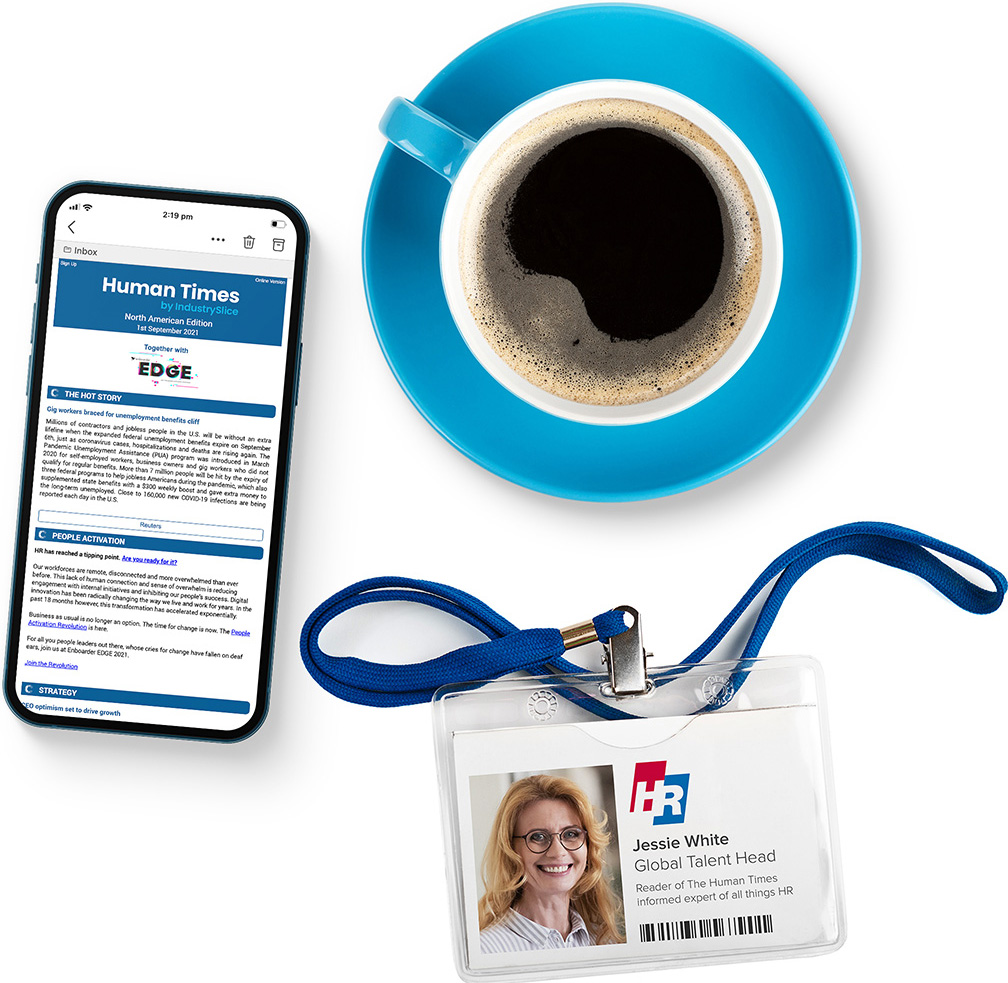
You’re all signed up for the Human Times
Thank you for your interest in our service.
Watch out for a confirmation email from our subscriptions team. Once you have confirmed you will join the worldwide community of over 30,000 subscribers who are receiving daily HR intelligence to lead, innovate and grow.
Note: Due to the nature of this message you may find this in your "promotions" or "spam" folders, please check there. If nothing arrives within a few minutes let us know. If you do not receive this email we will be happy to help get you set up.
Adding the email address [email protected], will help to ensure all newsletters arrive directly to your inbox.

Of all the newsletters I receive a month, Human Times has been easily the most valuable and a real pleasure to read.
I share it with my department, I excerpt it for other members of the C-Suite. And – we shook our heads trying to understand what the source organization is and what ultimately funds it.

“Although I’m a recent subscriber I really enjoy taking a few minutes to read through the selection of articles.
In terms of how I use it – I use it to stay informed on the range of human centred topics that the newsletter covers. I wouldn’t change anything – it’s extremely useful as-is.
Thoroughly enjoy this daily summary of news and tidbits.
We’ve used to start new conversations or dialogue on matters we are in process but getting differing viewpoints. The strategy and the technology sections are always very useful.
I find it very helpful for the busy executive who doesn't always have the time to read the newspaper or go online.
Being delivered to my In-Box gives me the opportunity to review when/where I can throughout the day.
Recent Editions

Human Times
North America
Wells Fargo has suspended all travel to China after a banker was blocked from leaving the country, Reuters reports. The move follows Chenyue Mao, a Shanghai-born and Atlanta-based managing director at the banking giant, being subjected to an exit ban after she recently entered China. "We are closely tracking this situation and working through the appropriate channels so our employee can return to the United States as soon as possible," Wells Fargo said. A White House official said they could not comment on the reports of Mao being refused permission to leave China.
Full Issue
Human Times
UK
The hospitality sector has experienced "devastating" job losses, with over 108,000 payroll positions disappearing in the past year, according to the Office for National Statistics. Unemployment has surged to a four-year high of 4.7%, while average pay growth has dropped to 5%, the lowest since June 2022. Kate Nicholls, chairman of UK Hospitality, said: "These devastating job losses are a direct consequence of policy decisions at last year's Budget. The change to employer NICs in particular, was socially regressive and had a disproportionate impact on entry-level jobs."
Full Issue
Human Times
Europe
Bloomberg reports that around 450 employees of Hungarian low cost carrier Wizz Air have been left in limbo after the airline announced the suspension of flights from Abu Dhabi from September. Wizz Air CEO Jozsef Varadi held a call with the employees and offered them the opportunity to take another job across the budget carrier's European network; however it is reported that many will find it difficult to migrate to Europe. A Wizz Air Abu Dhabi employee, who did not wish to be named, confirmed that airline management had held a conference call with staff, offering them different options.
Full Issue
Human Times
Middle East
Meta Platforms chief executive Mark Zuckerberg has announced that the Facebook parent company will invest hundreds of billions of dollars to construct several large artificial intelligence data centres aimed at advancing superintelligence, with the first centre, Prometheus, expected to be operational by 2026. His ambitious plan includes the establishment of multiple "titan clusters," one of which will cover a significant area comparable to Manhattan, as Meta seeks to enhance its competitive edge in the AI sector amid a talent acquisition drive for top engineers.
Full Issue
Read the latest HR highlights

How HR is Tackling Long Covid?
Fingers remain tightly crossed around the world that the rampant hospitalization and fatality stage of the Covid-19 pandemic has generally peaked. Vaccination programmes are accelerating, and restrictions are gradually being lifted...
Discover
ESG Is Not Just Another Name For CSR
Back in the distant 1980s if you wanted to demonstrate your environmental and ethical credentials it was sufficient to shop at or purchase shares in retailer The Body Shop. The charismatic Anita Roddick, founder of the “hippy” tinged retail chain, heralded a new age of environmental concern, caring capitalism and corporate awareness that evolved into what became known as Corporate Social Responsibility (CSR). CSR was much talked about and lauded, but in reality often ended up being a lot of a hot air (excuse the pun) and often never progressed much beyond a footnote in the annual report.
Discover
Have Older Workers Paid The Highest COVID-19 Price?
Across the world the pandemic is slowly but surely moving into its next phase. Recovery beckons. As furlough schemes across the U.S. and U.K. are being wound down, restrictions eased or lifted, and workforces moving back up the gears, early signs indicate that older employees are more likely to be casualties of the pandemic aftermath than their younger colleagues. Here at the we have witnessed an increasing number of stories supporting the growing belief that older workers are disproportionately paying the highest Covid-19 price.
Discover
Bosses. What's not to like? Plenty, say employees
“You’ll never have another boss like me, someone who’s basically a chilled-out entertainer”
So said, David Brent, the fictional manager of Slough-based paper merchant Wernham Hogg in the seminal TV comedy The Office. Ricky Gervais’s portrayal of Brent as a flawed, narcissistic, incompetent, and deluded manager was so well observed that many (including me) believed it was a genuine fly-on-the-wall documentary when they alighted accidentally on the first ever episode.

Rolling with the Payroll
To mark National Payroll Week the team at the Human Times has provided some insight into the industry that we hope you’ll find useful.
Discover
